
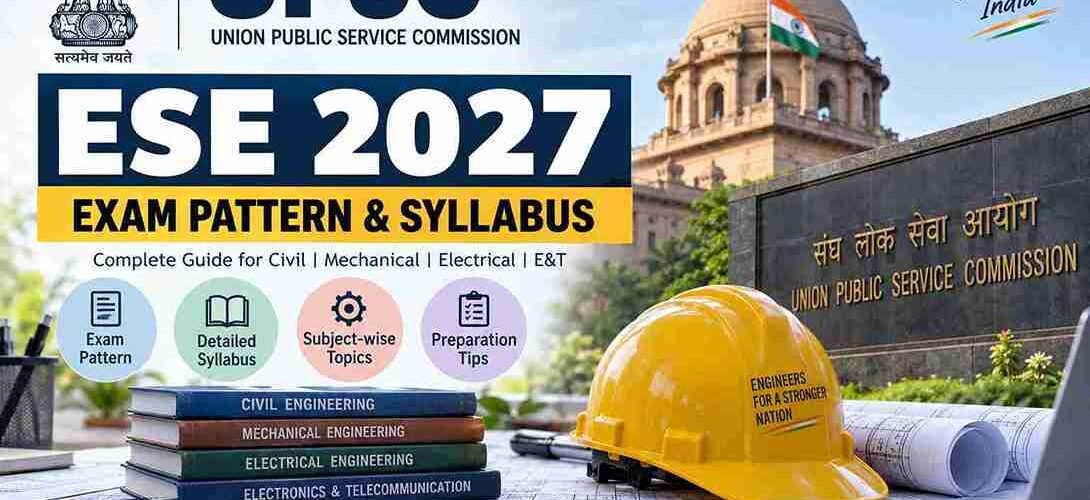
The UPSC ESE 2027 Exam Pattern and Syllabus are important for candidates preparing for the Engineering Services Examination conducted by the Union Public Service Commission. UPSC ESE, also known as the Engineering Services Examination or Indian Engineering Services examination, is conducted for recruitment to various engineering services and posts under the Government of India.
The UPSC ESE 2027 selection process consists of three stages: Preliminary Examination, Main Examination and Personality Test. The Preliminary Examination carries 500 marks, the Main Examination carries 600 marks, and the Personality Test carries 200 marks. Therefore, the total marks considered across all three stages are 1,300.
UPSC ESE 2027 Notification Out, Apply Online for 480 Posts
For 2027, the UPSC ESE Preliminary Examination is scheduled for 31 January 2027, while the Main Examination is scheduled for 18 June 2027. The examination covers four engineering disciplines: Civil Engineering, Mechanical Engineering, Electrical Engineering, and Electronics & Telecommunication Engineering.
Candidates should understand the examination structure before beginning preparation because the Preliminary and Main examinations test engineering knowledge in different formats. The Preliminary examination is objective, whereas the Main examination uses conventional/descriptive papers.
UPSC ESE 2027 Exam Pattern
The UPSC ESE examination is conducted in three stages:
- Engineering Services Preliminary Examination
- Engineering Services Main Examination
- Personality Test
The first stage is designed as a screening and merit-counting examination. Candidates who qualify for the Preliminary stage are allowed to appear for the Main examination according to the conditions prescribed by UPSC.
Candidates who qualify in the Main examination are subsequently called for the Personality Test.
UPSC ESE 2027 Exam Pattern at a Glance
| Stage | Papers | Type | Total Marks |
|---|---|---|---|
| Preliminary | 2 | Objective | 500 |
| Main | 2 | Conventional/Descriptive | 600 |
| Personality Test | — | Interview | 200 |
| Total | 1,300 |
The Preliminary Examination has a General Studies and Engineering Aptitude paper and a discipline-specific engineering paper.
The Main Examination consists of two conventional engineering papers belonging to the candidate’s selected engineering discipline.
UPSC ESE 2027 Preliminary Exam Pattern
The Preliminary Examination, also called Stage-I, consists of two objective-type papers.
| Paper | Subject | Duration | Marks |
|---|---|---|---|
| Paper-I | General Studies and Engineering Aptitude | 2 Hours | 200 |
| Paper-II | Engineering Discipline | 3 Hours | 300 |
| Total | 5 Hours | 500 |
Candidates have to appear for both papers.
The engineering discipline selected for Paper-II must correspond to the engineering category for which the candidate is eligible.
The four engineering categories are:
- Civil Engineering
- Mechanical Engineering
- Electrical Engineering
- Electronics & Telecommunication Engineering
Paper-I: General Studies and Engineering Aptitude
The first paper is common to candidates from all four engineering disciplines.
It carries 200 marks and is conducted for 2 hours.
The paper broadly tests a candidate’s understanding of engineering aptitude, reasoning, mathematics, current issues and fundamental engineering concepts.
Major Areas in General Studies and Engineering Aptitude
The important areas include:
- Current issues of national and international importance
- Logical reasoning
- Analytical ability
- Engineering mathematics
- General principles of engineering
- Engineering aptitude
- Engineering ethics
- Project management
- Quality control
- Standards and quality practices
- Energy and environment
- Information and communication technologies
- Basics of engineering drawing
- Design principles
- Safety
- Materials and manufacturing fundamentals
Candidates should not treat Paper-I as a conventional general knowledge paper. Engineering-related aptitude and applied concepts form an important part of the paper.
UPSC ESE 2027 Main Exam Pattern
Candidates qualifying in the Preliminary Examination are eligible to proceed to Stage-II, subject to UPSC’s qualifying requirements.
The Main Examination consists of two conventional engineering papers.
| Paper | Subject | Duration | Marks |
|---|---|---|---|
| Paper-I | Engineering Discipline | 3 Hours | 300 |
| Paper-II | Engineering Discipline | 3 Hours | 300 |
| Total | 6 Hours | 600 |
Unlike the objective Preliminary Examination, the Main Examination requires candidates to provide descriptive answers and demonstrate their ability to explain engineering concepts, solve numerical problems and apply theoretical knowledge.
The two Main papers together cover the prescribed syllabus of the candidate’s engineering discipline.
UPSC ESE 2027 Personality Test
Candidates who qualify for the Main Examination are called for the Personality Test.
The Personality Test carries 200 marks.
The interview is not simply a test of academic knowledge. It provides an opportunity for the Commission to assess the candidate’s suitability for engineering services, including qualities relevant to public service and the responsibilities associated with the post.
The final merit is prepared in accordance with the marks obtained at the different stages and the applicable UPSC rules.
UPSC ESE 2027 Negative Marking
The Preliminary Examination contains objective-type questions and carries negative marking.
For an incorrect answer, one-third of the marks assigned to that question is deducted.
No deduction is made where a candidate leaves a question unanswered.
Therefore, candidates should avoid excessive guessing and develop a strategy for handling questions where they are uncertain.
The detailed instructions concerning marking and examination conduct should always be checked in the current UPSC notification.
UPSC ESE 2027 Syllabus
The UPSC ESE syllabus is divided into a common General Studies and Engineering Aptitude component and four discipline-specific engineering syllabi.
The four engineering disciplines are:
Civil Engineering | Mechanical Engineering | Electrical Engineering | Electronics & Telecommunication Engineering
The following sections provide a detailed topic-wise preparation framework.
UPSC ESE Civil Engineering Syllabus
Civil Engineering candidates need to prepare a broad range of subjects covering structural engineering, geotechnical engineering, water resources, environmental engineering, transportation and construction management.
1. Building Materials
Important topics include:
- Stones
- Lime
- Glass
- Plastics
- Steel
- Fibre-reinforced materials
- Ceramics
- Aluminium
- Fly ash
- Timber
- Bricks
- Aggregates
- Cement
- Mortars
- Concrete
- Concrete properties and testing
- Cement testing
- Mix design
- Admixtures
Candidates should understand both theoretical properties and practical applications of construction materials.
2. Solid Mechanics
Important topics include:
- Stress and strain
- Elastic constants
- Plane stress
- Plane strain
- Principal stresses
- Mohr’s circle
- Elastic theories of failure
- Bending
- Shear
- Torsion
- Deformation of structural members
3. Structural Analysis
The structural analysis portion covers:
- Determinate structures
- Indeterminate structures
- Beams
- Trusses
- Frames
- Bending moment
- Shear force
- Influence lines
- Rolling loads
- Unit load method
- Structural vibrations
- Single-degree-of-freedom systems
- Multi-degree-of-freedom systems
- Suspended cables
- Computer-aided structural design concepts
4. Design of Steel Structures
Candidates should study:
- Working stress method
- Tension members
- Compression members
- Beams
- Beam-column connections
- Built-up sections
- Girders
- Industrial roofs
- Ultimate load design
5. Design of Concrete and Masonry Structures
Major topics include:
- Limit state design
- Reinforced concrete beams
- Slabs
- Columns
- Shear
- Axial compression
- Combined forces
- Foundations
- Retaining walls
- Tanks
- Staircases
- Lintels
- Prestressed concrete
- Earthquake-resistant design
- Masonry structures
6. Construction Practice, Planning and Management
This section includes:
- Construction planning
- Construction equipment
- Site investigation
- Estimation
- Project management
- Network analysis
- Rate analysis
- Tendering
- Contract management
- Quality control
- Productivity
- Operation cost
- Land acquisition
- Labour safety
- Labour welfare
7. Fluid Mechanics and Hydraulic Machines
Important topics include:
- Fluid properties
- Fluid kinematics
- Fluid dynamics
- Dimensional analysis
- Flow measurement
- Boundary layer
- Drag and lift
- Open-channel flow
- Hydraulic jump
- Pipe flow
- Pipe networks
- Pumps
- Hydraulic turbines
- Hydraulic machinery
- Hydropower plants
8. Hydrology and Water Resources Engineering
Major areas include:
- Hydrological cycle
- Groundwater
- Well hydrology
- Stream gauging
- River systems
- Floods
- Irrigation
- Water resources planning
- Reservoirs
- Dams
- Water distribution
- Drainage
9. Environmental Engineering
Candidates should prepare:
- Water quality
- Water treatment
- Water supply systems
- Sewerage
- Wastewater treatment
- Air pollution
- Solid waste management
- Environmental impact
- Industrial pollution
- Environmental legislation and standards
10. Geotechnical Engineering
Important areas include:
- Soil mechanics
- Soil classification
- Soil properties
- Permeability
- Seepage
- Consolidation
- Shear strength
- Bearing capacity
- Earth pressure
- Slope stability
- Foundations
- Ground improvement
11. Transportation Engineering
The syllabus broadly covers:
- Highway engineering
- Traffic engineering
- Pavement materials
- Pavement design
- Railway engineering
- Airport engineering
- Transportation planning
- Traffic control
- Road safety
12. Surveying and Geology
Candidates should study:
- Chain surveying
- Compass surveying
- Levelling
- Theodolite
- Contouring
- Plane table surveying
- Tacheometry
- Modern surveying instruments
- Remote sensing concepts
- Engineering geology
- Geological structures
- Rocks and minerals
The UPSC’s published ESE syllabus documentation provides detailed Civil Engineering topics across building materials, solid mechanics, structural analysis, steel and concrete design, construction management, fluid mechanics, hydrology and other areas.
UPSC ESE Mechanical Engineering Syllabus
Mechanical Engineering candidates need to cover core mechanical subjects along with thermal, manufacturing and industrial engineering topics.
1. Engineering Mechanics and Strength of Materials
Topics include:
- Engineering mechanics
- Force systems
- Equilibrium
- Friction
- Centroid
- Moment of inertia
- Kinematics
- Dynamics
- Stress
- Strain
- Bending
- Torsion
- Shear
- Columns
- Failure theories
2. Theory of Machines
Important areas include:
- Mechanisms
- Kinematics
- Velocity analysis
- Acceleration analysis
- Gears
- Gear trains
- Flywheels
- Governors
- Balancing
- Vibrations
- Cams
- Bearings
3. Machine Design
Major topics include:
- Design principles
- Machine components
- Shafts
- Couplings
- Bearings
- Keys
- Springs
- Gears
- Brakes
- Clutches
- Pressure vessels
- Fatigue
- Failure theories
4. Thermodynamics
Candidates should prepare:
- Basic thermodynamic concepts
- First law
- Second law
- Entropy
- Availability
- Thermodynamic cycles
- Properties of pure substances
- Gas mixtures
- Steam
- Boilers
- Nozzles
- Compressors
5. Fluid Mechanics
Topics include:
- Fluid properties
- Fluid statics
- Fluid dynamics
- Bernoulli equation
- Dimensional analysis
- Flow measurement
- Pipe flow
- Boundary layers
- Turbomachinery
- Pumps
- Hydraulic machines
6. Heat Transfer
Important topics include:
- Conduction
- Convection
- Radiation
- Heat exchangers
- Thermal insulation
- Heat transfer through fins
- Transient heat conduction
- Heat exchanger analysis
7. IC Engines
Major areas include:
- SI engines
- CI engines
- Engine cycles
- Engine components
- Fuel systems
- Cooling
- Lubrication
- Combustion
- Engine testing
- Emissions
8. Refrigeration and Air Conditioning
Topics include:
- Refrigeration cycles
- Vapour compression
- Vapour absorption
- Refrigerants
- Psychrometry
- Air conditioning systems
- Cooling load
- HVAC equipment
9. Power Plant Engineering
Candidates should study:
- Thermal power plants
- Hydroelectric power
- Nuclear power
- Gas turbine plants
- Combined cycles
- Boilers
- Turbines
- Plant economics
- Energy management
10. Manufacturing Engineering
Major areas include:
- Casting
- Welding
- Machining
- Metal forming
- Cutting tools
- CNC machines
- Production processes
- Metrology
- Quality control
- Computer-integrated manufacturing
11. Industrial Engineering
Important topics include:
- Work study
- Operations research
- Production planning
- Inventory management
- Supply chain
- Quality management
- Project management
- Maintenance
- Reliability
UPSC ESE Electrical Engineering Syllabus
Electrical Engineering candidates should focus on electrical circuits, machines, power systems, measurements, control systems and power electronics.
1. Electrical Circuits
Important topics include:
- Circuit laws
- Network theorems
- DC circuits
- AC circuits
- Resonance
- Transients
- Two-port networks
- Laplace transforms
- Network analysis
2. Electrical and Electronic Measurements
Major topics include:
- Measurement systems
- Measuring instruments
- Errors
- Bridges
- Potentiometers
- Digital instruments
- Transducers
- Oscilloscopes
- Instrumentation
3. Electrical Machines
Candidates should prepare:
- Transformers
- DC machines
- Induction motors
- Synchronous machines
- Special machines
- Machine characteristics
- Starting and braking
- Speed control
- Losses and efficiency
4. Power Systems
Important areas include:
- Generation
- Transmission
- Distribution
- Power system analysis
- Load flow
- Fault analysis
- Stability
- Power factor
- Transmission lines
- Underground cables
- Economic operation
5. Power Electronics
Topics include:
- Semiconductor devices
- Diodes
- Thyristors
- Controlled rectifiers
- Choppers
- Inverters
- Cycloconverters
- Power electronic applications
6. Control Systems
Candidates should study:
- Open-loop systems
- Closed-loop systems
- Transfer functions
- Block diagrams
- Signal flow graphs
- Stability
- Root locus
- Frequency response
- State-space analysis
- Controllers
7. Analog and Digital Electronics
Important areas include:
- Semiconductor devices
- Amplifiers
- Oscillators
- Operational amplifiers
- Digital logic
- Boolean algebra
- Combinational circuits
- Sequential circuits
- A/D and D/A converters
- Digital systems
8. Electrical Materials
Topics include:
- Conductors
- Insulators
- Magnetic materials
- Dielectric materials
- Semiconductor materials
- Properties and applications of electrical materials
UPSC ESE Electronics & Telecommunication Engineering Syllabus
The Electronics & Telecommunication Engineering syllabus covers electronics, communication, networks, control, digital systems and electromagnetic theory.
1. Electronic Devices and Circuits
Topics include:
- Semiconductor physics
- Diodes
- Transistors
- Field-effect transistors
- Amplifiers
- Oscillators
- Feedback
- Power amplifiers
2. Analog Electronics
Important areas include:
- Operational amplifiers
- Amplifier circuits
- Oscillators
- Filters
- Voltage regulators
- Power supplies
- Signal conditioning
3. Digital Electronics
Candidates should prepare:
- Number systems
- Boolean algebra
- Logic gates
- Combinational circuits
- Sequential circuits
- Flip-flops
- Counters
- Registers
- Memories
- Digital logic families
4. Signals and Systems
Major topics include:
- Continuous-time signals
- Discrete-time signals
- Linear systems
- Time-domain analysis
- Fourier analysis
- Laplace transforms
- Z-transforms
- Sampling
5. Communication Systems
Important areas include:
- Analog communication
- Digital communication
- Modulation
- Demodulation
- Noise
- Information theory
- Coding
- Multiplexing
- Communication channels
6. Electromagnetic Theory
Topics include:
- Electrostatics
- Magnetostatics
- Maxwell’s equations
- Electromagnetic waves
- Transmission lines
- Waveguides
- Antennas
- Propagation
7. Microwave Engineering
Candidates should study:
- Microwave components
- Microwave tubes
- Semiconductor microwave devices
- Waveguides
- Microwave measurements
- Radar fundamentals
8. Control Systems
Major areas include:
- System modelling
- Transfer functions
- Feedback
- Stability
- Root locus
- Frequency response
- State-space analysis
- Controllers
9. Microprocessors and Microcontrollers
Important topics include:
- Microprocessor architecture
- Instruction sets
- Interfacing
- Memory systems
- Microcontrollers
- Timers
- Serial communication
- Embedded applications
10. Computer and Data Communication
Topics include:
- Computer fundamentals
- Data communication
- Networking
- Network protocols
- Communication interfaces
- Data transmission
- Network architecture
UPSC ESE 2027 Paper-Wise Preparation Strategy
The ESE preparation strategy should be different for each stage.
For the Preliminary Examination, candidates should focus heavily on speed, accuracy and objective problem solving.
For the Main Examination, preparation should shift towards conceptual depth, numerical solving, derivations and structured descriptive answers.
Preparing for Paper-I
Paper-I is common to all engineering disciplines. Candidates should regularly revise:
- Engineering mathematics
- Engineering aptitude
- Logical reasoning
- Current engineering developments
- Project management
- Environmental issues
- Quality and standards
- Engineering ethics
- ICT
- Basic engineering concepts
A candidate should also solve previous UPSC ESE questions because the actual examination requires quick application of concepts.
Preparing for the Engineering Paper
The engineering paper contributes a larger share of the Preliminary marks than Paper-I.
Candidates should therefore divide preparation into three stages:
Concept Building → Question Practice → Revision
During concept building, focus on understanding formulas and fundamental principles.
During question practice, solve previous-year questions and timed mock tests.
During revision, maintain a compact formula and concept notebook.
UPSC ESE Main Examination Preparation
The Main Examination requires a different answer-writing approach.
Candidates should practise:
- Step-by-step numerical solutions
- Diagrams
- Engineering assumptions
- Relevant formulas
- Derivations
- Units
- Clear explanations
- Proper presentation
- Time management
A technically correct answer can still lose marks if the solution is poorly organised or important steps are omitted.
Candidates should therefore begin descriptive answer practice well before the Preliminary Examination result.
UPSC ESE 2027 Syllabus: Subject-Wise Weightage
UPSC does not prescribe a fixed official chapter-wise question weightage for every examination.
Therefore, candidates should not assume that every subject will contribute a predetermined number of questions.
However, preparation should cover the complete prescribed syllabus because the Commission can vary the distribution of questions from year to year.
Previous-year papers can be used to identify recurring themes and understand the relative importance of different topics, but they should not be treated as a guarantee of the 2027 paper pattern.
How to Complete UPSC ESE 2027 Syllabus
A practical preparation cycle can be divided into four phases.
Phase 1: Complete the Fundamentals
Build strong concepts in every core engineering subject.
Phase 2: Solve Previous-Year Questions
After completing each subject, solve relevant UPSC ESE questions.
This helps candidates understand how theoretical concepts are converted into examination questions.
Phase 3: Full-Length Practice
Once a significant portion of the syllabus is complete, start solving full-length objective papers under examination conditions.
Phase 4: Revision and Main Answer Writing
Before the Preliminary Examination, focus on revision, formula retention and mock tests.
After qualifying the Preliminary Examination, shift immediately toward descriptive answer writing for the Main Examination.
UPSC ESE 2027 Important Exam Dates
| Event | Date |
|---|---|
| UPSC ESE 2027 Notification | 16 September 2026 |
| Application Begins | 16 September 2026 |
| Last Date to Apply | 6 October 2026 |
| Preliminary Examination | 31 January 2027 |
| Main Examination | 18 June 2027 |
| Personality Test | To be announced |
The current examination schedule confirms the 31 January 2027 Preliminary Examination and 18 June 2027 Main Examination dates.
UPSC ESE 2027 Previous Year Question Papers
Previous-year papers are one of the most useful resources for understanding the actual difficulty and style of UPSC ESE questions.
Download All UPSC ESE Previous Year Papers 2024, 2025, and 2026
Candidates should practise papers for their respective engineering discipline and analyse:
- Repeated concepts
- Numerical difficulty
- Time required
- Frequently tested formulas
- Conceptual questions
- Calculation-heavy topics
- Areas where mistakes occur
UPSC maintains an official section for previous question papers and examination material on its website.
Engineering Services (Preliminary) Examination, 2026
| Paper – I General Studies and Engineering Aptitude (17.53 MB) Paper – II Electrical Engineering (18.5 MB) Paper – II Electronics and Telecommunication Engineering (18.91 MB) Paper – II Mechanical Engineering (16.73 MB) Paper – II Civil Engineering (16.58 MB) |
Engineering Services (Main) Examination, 2026
| Civil Engineering Paper – I (6.27 MB) Civil Engineering Paper – II (3.58 MB) Mechanical Engineering Paper – I (6.13 MB) Mechanical Engineering Paper – II (4.21 MB) Electrical Engineering Paper – I (4.61 MB) Electrical Engineering Paper – II (4.2 MB) Electronics and Telecommunication Engineering Paper – I (3.81 MB) Electronics and Telecommunication Engineering Paper – II (3.92 MB) |
UPSC ESE 2027 Exam Pattern and Syllabus: Important Points
Before beginning preparation, candidates should remember these key points:
- UPSC ESE has three selection stages.
- Preliminary Examination carries 500 marks.
- Main Examination carries 600 marks.
- Personality Test carries 200 marks.
- Preliminary Examination is objective.
- Main Examination is conventional/descriptive.
- Paper-I of Prelims is common to all engineering disciplines.
- Paper-II is based on the selected engineering discipline.
- There are four engineering categories.
- Negative marking applies to incorrect answers in the objective Preliminary Examination.
- The Preliminary Examination is scheduled for 31 January 2027.
- The Main Examination is scheduled for 18 June 2027.
UPSC ESE 2027 Preparation Tips
Candidates should avoid preparing only the subjects they find comfortable.
The ESE syllabus is broad, and preparation needs consistency across the entire engineering discipline.
A good preparation routine should combine:
Theory + Previous-Year Questions + Mock Tests + Revision + Error Analysis
Candidates should maintain an error notebook containing formulas, concepts and question types where they repeatedly make mistakes.
For the Main Examination, answer-writing practice should be added early rather than waiting until after the Preliminary result.
Frequently Asked Questions
| What is the UPSC ESE 2027 exam pattern? |
|---|
| UPSC ESE 2027 consists of Preliminary Examination, Main Examination and Personality Test. The Preliminary stage carries 500 marks, the Main stage 600 marks and the Personality Test 200 marks. |
| How many papers are there in UPSC ESE Prelims? |
| There are two papers in the Preliminary Examination: General Studies and Engineering Aptitude, and the discipline-specific Engineering Paper. |
| What are the four UPSC ESE engineering disciplines? |
| The four disciplines are Civil Engineering, Mechanical Engineering, Electrical Engineering, and Electronics & Telecommunication Engineering. |
| Is UPSC ESE Prelims objective? |
| Yes. The Preliminary Examination consists of objective-type papers. |
| Is UPSC ESE Mains descriptive? |
| Yes. The Main Examination consists of conventional/descriptive engineering papers. |
| How many marks is UPSC ESE Prelims? |
| The Preliminary Examination carries 500 marks. |
| How many marks is UPSC ESE Mains? |
| The Main Examination carries 600 marks. |
| How many marks is the UPSC ESE Personality Test? |
| The Personality Test carries 200 marks. |
| Is there negative marking in UPSC ESE? |
| Yes. Negative marking applies to incorrect answers in the objective Preliminary Examination. One-third of the marks assigned to the question is deducted for an incorrect answer. |
| When will UPSC ESE Prelims 2027 be conducted? |
| The UPSC ESE Preliminary Examination 2027 is scheduled for 31 January 2027. |
| When will UPSC ESE Mains 2027 be conducted? |
| The UPSC ESE Main Examination 2027 is scheduled for 18 June 2027. |
| Where can I find the official UPSC ESE syllabus? |
| Candidates should refer to the UPSC’s official Engineering Services Examination notification and syllabus documents. The UPSC website provides examination notifications, previous question papers and other examination resources. |
The UPSC ESE 2027 Exam Pattern and Syllabus cover a substantial range of engineering and aptitude subjects. Candidates should understand the three-stage examination structure before creating their preparation plan.
The Preliminary Examination tests candidates through objective papers, while the Main Examination requires detailed conventional answers. The Personality Test completes the selection process.
Because the engineering paper carries a significant portion of the examination marks, candidates should build strong fundamentals in their chosen discipline while simultaneously preparing the common General Studies and Engineering Aptitude paper.
With the Preliminary Examination scheduled for 31 January 2027, candidates have a defined examination date around which they can structure their preparation, revision and mock-test schedule. The official UPSC notification and subsequent Commission notices should remain the final authority for any changes to the scheme, syllabus or examination schedule.